Wednesday, October 12, 2005


Adding Column Field on Table imported from Xls
I used to get data from Finance in Excel format and they wanted me to put them into an Access Database. The imported tables always end up missing with few column fields necessary in the MS Access Reporting later on. Here is how I did it.
Private Sub CMD_ImportXlsTable_Click()
On Error GoTo Err_CMD_ImportXlsTable_Click
If IsNull(Me.FileNameCombo) Then
prompt = MsgBox("Please choose the Filename to process.", vbOKOnly, "Warning!!!")
Exit Sub
Else
ImportXlsTable
If Me.FileNameCombo = 2 Then 'WIRELESS BALANCE ON HAND
DoCmd.SetWarnings False
'***This corrects the entry WNPM into WNPM-W StockRoom
DoCmd.OpenQuery "Update Wireless WNPM to WNPM-W Q", acViewNormal
'***This corrects the entry in LOC_AV field by removing the blank prefixes
DoCmd.OpenQuery "Update Imp BOH LOC_AV Q", acViewNormal
DoCmd.SetWarnings True
Else
GoTo ProcessCartons
End If
ProcessCartons:
If Me.FileNameCombo = 7 Then 'Cartons Wireless issued not shipped
'***ADD Additional Column Fields called:
'***Found, Remarks
Dim SQL As String
For i = 1 To 4
Select Case i
Case 1
SQL = "ALTER TABLE [Wcartons issued not shipped] ADD COLUMN Found YESNO"
DoCmd.RunSQL SQL
Case 2
SQL = "ALTER TABLE [Wcartons issued not shipped] ADD COLUMN Remarks Text(100)"
DoCmd.RunSQL SQL
Case 3
SQL = "ALTER TABLE [Wcartons issued not shipped] ADD COLUMN Count Long"
DoCmd.RunSQL SQL
Case 4
SQL = "ALTER TABLE [Wcartons issued not shipped] ADD COLUMN IBIN Text(50)"
DoCmd.RunSQL SQL
End Select
Next i
Else
'Exit Sub
End If
End If
Exit_CMD_ImportXlsTable_Click:
Exit Sub
Err_CMD_ImportXlsTable_Click:
MsgBox Err.Description
Resume Exit_CMD_ImportXlsTable_Click
End Sub
Exporting Table into a Backend Database
1. Create first the following function:
Function PutTableOnBackEnd(DBName As String, TblName As String, DestinationTable As String) As Boolean
'DBName should include full path and name of back end database
Dim Db As Database
'test back end
On Error Resume Next
Set Db = OpenDatabase(DBName)
If Err <> 0 Then
'failed to open back end database
Exit Function
End If
If Not Db Is Nothing Then Db.Close
'test if table is local
If IsNull(DLookup("Type", "MSysObjects", "Name='" & TblName & "' AND Type=1")) Then
'table is not local
Exit Function
End If
'put table on back end
'DoCmd.TransferDatabase acExport, "Microsoft Access", DBName, acTable, TblName, TblName
DoCmd.TransferDatabase acExport, "Microsoft Access", DBName, acTable, TblName, DestinationTable
If Err <> 0 Then GoTo Done
'link to the back end table
'DoCmd.DeleteObject acTable, TblName
'DoCmd.TransferDatabase acLink, "Microsoft Access", DBName, acTable, TblName, TblName
PutTableOnBackEnd = True 'defaults to false if it fails to get here
Done:
End Function
2. Specify the Tables to Export:
| Tables to Export | |||
| TableID | TableName | Directory | BackEndDB |
| 1 | API Control Table | \\zwnwb080\groups\API_UPDATES\API\Upload | BackEnd.mdb |
| 2 | APIData Table | \\zwnwb080\groups\API_UPDATES\API\Upload | BackEnd.mdb |
| 3 | Unused ControlNo Table | \\zwnwb080\groups\API_UPDATES\API\Upload | BackEnd.mdb |
| | | | |
3. Call the Function in a command button of a form:
Private Sub CMD_ExportTable_Click()
Dim Result As Boolean
Dim strPC As String
Dim SourceTable As String
Dim DestTable As String
Dim strDirectory As String
Dim BackEndDB As String
strPC = Me.TxtPCName
For i = 1 To 3
‘Specify the Table Names
SourceTable = DLookup("[TableName]", "Tables to Export", "[TableID] =" & i)
DestTable = strPC & "-" & SourceTable 'Here I attached the PC Name for Record Purposes
strDirectory = DLookup("[Directory]", "Tables to Export", "[TableID] =" & i)
BackEndDB = DLookup("[BackEndDB]", "Tables to Export", "[TableID] =" & i)
‘Call the Function
Result = PutTableOnBackEnd(strDirectory & "\" & BackEndDB, SourceTable, DestTable)
Debug.Print Result
MsgBox ("Finish exporting " & SourceTable)
Next i
End Sub
Saturday, October 08, 2005
Compacting Access Db at specified time
How to Compact Databases at a Scheduled Time
View products that this article applies to.
url REFERENCE: http://support.microsoft.com/?id=158937
Moderate: Requires basic macro, coding, and interoperability skills.
SUMMARY: This article describes two methods that you can use to start to compact one or more databases automatically at a scheduled time. In the first method, you create a small database with a table, a form, and a macro. The table stores the names of the databases you want to compact. The form contains a procedure in the Timer event that starts to compact the databases whose names are in the table. The macro opens the form every time you open the database.
In the second method, you can use a scheduling utility, such as the NT Schedule Service, to open an Access database by using the /compact command line switch.
This article assumes that you are familiar with Visual Basic for Applications and with creating Access applications by using the programming tools that are provided with Access. For more information about Visual Basic for Applications, see your version of the "Building Applications with Microsoft Access" manual.
NOTE: Visual Basic for Applications is called Microsoft Access Basic in Access version 2.0. For more information about Access Basic, see the "Building Applications" manual.
In the second method, you can use a scheduling utility, such as the NT Schedule Service, to open an Access database by using the /compact command line switch.
This article assumes that you are familiar with Visual Basic for Applications and with creating Access applications by using the programming tools that are provided with Access. For more information about Visual Basic for Applications, see your version of the "Building Applications with Microsoft Access" manual.
NOTE: Visual Basic for Applications is called Microsoft Access Basic in Access version 2.0. For more information about Access Basic, see the "Building Applications" manual.
Thursday, October 06, 2005
INCREMENTAL NUMBERING SYSTEM
INCREMENTAL NUMBERING SYSTEM
SCENARIO: A certain table called API Temp Data needs to have an incremented numbering on ItemNo field. If we use autonumbering we cannot have multiple users entering at the same time in a given table. One item entered may contain number 1 by one user and the other user my have it’s entered item numbered as 2. In order to facilitate the automated numbering system starting with 1 with each user without using the autonumber of MS Acces is to create a procedure that will do the trick for you.
PROCEDURE:
The following is a portion of the procedure in the submit Record click event.
’***START Of INS Procedure
’***Programmer: Noel Jerome Q. Noel
‘***Contact:
‘1. Count the number of Records based on the ControlNo that is in the Form
RecCount = Nz(DCount("[ControlNo]", "Temp APIData", "[ControlNo]='" & Me.TxtControlNumber & "'"), 0)
‘2. If Record <> to zero then proceed to CallLoop
If RecCount <> 0 Then
GoTo CallLoop
Else
Me.TxtMultiTicketCounter.Value = 0
GoTo ExitingBasketProcedure
End If
CallLoop:
‘3. Set a Variable for the RecordSet you need to update
Set APITempDB = CurrentDb.OpenRecordset("SELECT * FROM [Temp APIData] WHERE ControlNo = '" & Me.TxtControlNumber & "'")
‘4. Initialize a counter called A
A = 1
‘5. Create a Loop Statement that will cycle through the recordset until the end of File
Do Until APITempDB.EOF
With APITempDB
.Edit
‘6. Each cycle updates ItemNo with counter A
!ItemNo = A
.Update
.MoveNext
End With
‘7. Counter A is incremented by 1
A = A + 1
‘8. Close the Recordset
APITempDB.Close
Me.TxtMultiTicketCounter.Value = RecCount
’***END Of INS Procedure
CHECKING CHARACTER FOR INTEGER OR STRING
CHECKING CHARACTER FOR INTEGER OR STRING
SCENARIO: A controlNo for inventory is formatted like:
1. For Multi Ticket = M05-00001
2. For Single Ticket = S05-00001
In order for the user not to enter a different format each character should be validated if they qualify as integer or String.
Here is the procedure in the AfterUpdate of the TxtControlNo Unbound Textbox:
The following procedure cycles through the series of characters in a textbox
'***Start of character Check for ControlNo String
’***Programmer: Noel Jerome Q. Noel
‘***Contact:
Dim X As Integer, i As Integer, intClength As Integer
Dim intSuffix As Long, NumCheck As Variant, ControlCheck As Variant
Dim RControlNo As String, StringConvert As String, StringCheck As String
intClength = Len(Me.TxtControlNumber)
X = 0
For i = 1 To intClength
RControlNo = Right(Me.TxtControlNumber.Value, intClength - X)
ControlCheck = Left(RControlNo, 1)
NumCheck = Nz(Val(ControlCheck), 0)
StringConvert = Str(NumCheck)
StringCheck = Right(StringConvert, Len(StringConvert) - 1)
If ControlCheck <> StringCheck Then
VarCheckType = "StringVar"
Else
VarCheckType = "IntegerVar"
End If
Select Case i
Case 1 'First Character should be string
If VarCheckType <> "StringVar" Then
prompt = MsgBox("You have entered a number instead of text on Character 1 of your ControlNo.", vbOKOnly, "Warning!!!")
Me.TxtControlNumber.Value = Null
Exit Sub
End If
Case 4 '4th Character should be a dash "-" string
If ControlCheck <> "-" Then
prompt = MsgBox("Character 4 of your ControlNo should be a dash '-' string. Change your ControlNo.", vbOKOnly, "Warning!!!")
Me.TxtControlNumber.Value = Null
Exit Sub
End If
Case Else 'Other Characters should be integer
If VarCheckType <> "IntegerVar" Then
prompt = MsgBox("You have entered a text instead of number on Character " & i & " of your ControlNo.", vbOKOnly, "Warning!!!")
Me.TxtControlNumber.Value = Null
Exit Sub
End If
End Select
X = X + 1
Next i
Tuesday, October 04, 2005
Increment Values in query
Reference:
global IncrementVariable as Long
function IncrementValues(i) as Long
IncrementVariable = IncrementVariable + 1
IncrementValues = IncrementVariable
end function
Note that it's necessary to pass a value to the function in order to have it count for each record. If you don't include this piece then you'll likely get a lot of 1's in every row instead of the counting result you'd like to see.
SELECT ... IncrementValues([any_field]) ...
You can futher customize this function, the following code with start over at 1 every 4 seconds, so if you run a query that numbers your table, it will start over at 1 on it's own next time you run the query (assuming it's > 4 seconds later).
global IncrementVariable as Long
global lastcall as Date
Function IncrementValues(i) As Long
If Now > (lastcall + 4 / 60 / 60 / 24) Then
lastcall = Now
IncrementVariable = 0
End If
IncrementVariable = IncrementVariable + 1
IncrementValues = IncrementVariable
End Function
And this one restarts every 4 seconds, and gives you the option of designating a starting point other than 1.
Function IncrementValues(i, Optional myBase As Long) As Integer
If Now > (lastcall + 2 / 60 / 60 / 24) Then
lastcall = Now
If myBase Then
IncrementVariable = myBase - 1
Else
IncrementVariable = 0
End If
End If
IncrementVariable = IncrementVariable + 1
IncrementValues = IncrementVariable
End Function
Finally, it's a good idea to choose data type Long instead of Integer, in case you have a lot of data... and if you're running on a P75, you might want to omit the timed restart, or do more than a 4 second delay, or it might restart at 1 in the middle of running a long slow query.
global IncrementVariable as Long
function IncrementValues(i) as Long
IncrementVariable = IncrementVariable + 1
IncrementValues = IncrementVariable
end function
Note that it's necessary to pass a value to the function in order to have it count for each record. If you don't include this piece then you'll likely get a lot of 1's in every row instead of the counting result you'd like to see.
SELECT ... IncrementValues([any_field]) ...
You can futher customize this function, the following code with start over at 1 every 4 seconds, so if you run a query that numbers your table, it will start over at 1 on it's own next time you run the query (assuming it's > 4 seconds later).
global IncrementVariable as Long
global lastcall as Date
Function IncrementValues(i) As Long
If Now > (lastcall + 4 / 60 / 60 / 24) Then
lastcall = Now
IncrementVariable = 0
End If
IncrementVariable = IncrementVariable + 1
IncrementValues = IncrementVariable
End Function
And this one restarts every 4 seconds, and gives you the option of designating a starting point other than 1.
Function IncrementValues(i, Optional myBase As Long) As Integer
If Now > (lastcall + 2 / 60 / 60 / 24) Then
lastcall = Now
If myBase Then
IncrementVariable = myBase - 1
Else
IncrementVariable = 0
End If
End If
IncrementVariable = IncrementVariable + 1
IncrementValues = IncrementVariable
End Function
Finally, it's a good idea to choose data type Long instead of Integer, in case you have a lot of data... and if you're running on a P75, you might want to omit the timed restart, or do more than a 4 second delay, or it might restart at 1 in the middle of running a long slow query.
Wednesday, September 21, 2005
Limitations of MS Access
REFERENCE: http://www.codeguru.com/forum/archive/index.php/t-235929.html
There is an article Microsoft Access 2000: Choosing between MSDE and Jet (http://www.microsoft.com/sql/techinfo/deployment/70/msdejet.asp) which lists all the limitations of Access database in the Word file (http://www.microsoft.com/sql/techinfo/deployment/70/Access2000MSDE.doc).
Here is extract:
"Appendix B: Access/Jet (.mdb) Specifications
File size (.mdb filetype) 2 GB
No. of objects in a database 32,768
Modules 1,000
Number of characters in an object name 64
Number of characters in a password 14
Number of characters in a user name or group name 20
Number of characters in a table name 64
Number of characters in a field name 64
Number of fields in a table 255
Number of open tables 2048.
Table size 1 gigabyte
Number of characters in a Text field 255
No. of characters in a Memo field (data entered via UI) 65,535
No.of char. in a Memo field (data entered programmatically) 1 gigabyte
Size of an OLE Object field 1 gigabyte
Number of indexes in a table 32
Number of fields in an index 10
Number of characters in a validation message 255
Number of characters in a validation rule 2,048
Number of characters in a table or field description 255
Number of characters in a record 2,000
Number of characters in a field property setting 255"
There is an article Microsoft Access 2000: Choosing between MSDE and Jet (http://www.microsoft.com/sql/techinfo/deployment/70/msdejet.asp) which lists all the limitations of Access database in the Word file (http://www.microsoft.com/sql/techinfo/deployment/70/Access2000MSDE.doc).
Here is extract:
"Appendix B: Access/Jet (.mdb) Specifications
File size (.mdb filetype) 2 GB
No. of objects in a database 32,768
Modules 1,000
Number of characters in an object name 64
Number of characters in a password 14
Number of characters in a user name or group name 20
Number of characters in a table name 64
Number of characters in a field name 64
Number of fields in a table 255
Number of open tables 2048.
Table size 1 gigabyte
Number of characters in a Text field 255
No. of characters in a Memo field (data entered via UI) 65,535
No.of char. in a Memo field (data entered programmatically) 1 gigabyte
Size of an OLE Object field 1 gigabyte
Number of indexes in a table 32
Number of fields in an index 10
Number of characters in a validation message 255
Number of characters in a validation rule 2,048
Number of characters in a table or field description 255
Number of characters in a record 2,000
Number of characters in a field property setting 255"
Monday, September 19, 2005
MS Access Programming JOB Links
1. http://www.craigslist.org/nby/cpg/94461117.html
2. http://www.tech-centric.net/search/anonymous/jobdetails.aspx?job=153839
3. http://www.tech-centric.net/search/anonymous/jobdetails.aspx?job=149688
4. Dice.Com
5. http://www.tech-centric.net/search/anonymous/jobdetails.aspx?job=137667
6. http://www.google.ca/search?hl=en&q=MS+Access+Programmer+%2B+jobs&meta=
7. http://www.net-temps.com/job/suda/965/ms_access_programmer.html
8. http://www.tech-centric.net/search/anonymous/jobdetails.aspx?job=147624
9. http://denver.craigslist.org/art/97270542.html
10. MS Access programmer on Baltimore
11. Fun JObs Review
12. Cambria Palo Alto MS Access Programming job
http://www.cambria.com/services_access.asp
RITA'S REFERENCE:
13. http://www.job4you.com/vb.htm
14. Careerbuilder.com
15. Microagility
16.ALR Asociates Inc.
17. KForce.Com
18. HR System Support Analyst - Adecco Technical
19. Indeed.Com Search Result
RESUME RABBIT: http://wvw.jobseekerweekly.com/cgi-bin/submitwriter.pl?ID=144
New Links:
1. http://www.programmingfromhome.com/
2. http://www.prgjobs.com/Job.cfm/217090
3.
2. http://www.tech-centric.net/search/anonymous/jobdetails.aspx?job=153839
3. http://www.tech-centric.net/search/anonymous/jobdetails.aspx?job=149688
4. Dice.Com
5. http://www.tech-centric.net/search/anonymous/jobdetails.aspx?job=137667
6. http://www.google.ca/search?hl=en&q=MS+Access+Programmer+%2B+jobs&meta=
7. http://www.net-temps.com/job/suda/965/ms_access_programmer.html
8. http://www.tech-centric.net/search/anonymous/jobdetails.aspx?job=147624
9. http://denver.craigslist.org/art/97270542.html
10. MS Access programmer on Baltimore
11. Fun JObs Review
12. Cambria Palo Alto MS Access Programming job
http://www.cambria.com/services_access.asp
RITA'S REFERENCE:
13. http://www.job4you.com/vb.htm
14. Careerbuilder.com
15. Microagility
16.ALR Asociates Inc.
17. KForce.Com
18. HR System Support Analyst - Adecco Technical
19. Indeed.Com Search Result
RESUME RABBIT: http://wvw.jobseekerweekly.com/cgi-bin/submitwriter.pl?ID=144
New Links:
1. http://www.programmingfromhome.com/
2. http://www.prgjobs.com/Job.cfm/217090
3.
Saturday, September 03, 2005
Thursday, September 01, 2005
Number of users Access can Accomodate
http://www.dbforums.com/archive/index.php/t-1079077.html
I agree Access is a very easy to start with database, but here are the
limitations to what Access can do:
1. The theoretical maximum number of concurrent users in an Access database
is 255. However, this figure is just the maximum
number possible, and you are more likely to find that the maximum number of
users is about 50-100, although depending on your
design, this might be less. This should certainly be borne in mind when
starting to design a database, as it is almost guaranteed that
although the initial brief called for only 15 users, after a year of
operation there will probably be twice that using the database.
Therefore over-engineering is required.
2. Also, Access isn't configured to run as a client/server database, so it
isn't optimized for running over a network. A true client/server
application will only call the data from the server to the client that are
needed. Therefore, you will probably see some network
performance degradation.
3. Access is also limited to how much data it can store. In Access 97, this
is 1 Gigabyte per database, and in Access
2000 it is 2Gb, although you can have multiple databases used to store
information in.
I believe this info is relevant for you to decide. I strongly recommmend
that if you haven't yet started with your app design,
switch to SQL as backend, and frontend with something as VB, that gives you
more flexibility and a far better UI.
I agree Access is a very easy to start with database, but here are the
limitations to what Access can do:
1. The theoretical maximum number of concurrent users in an Access database
is 255. However, this figure is just the maximum
number possible, and you are more likely to find that the maximum number of
users is about 50-100, although depending on your
design, this might be less. This should certainly be borne in mind when
starting to design a database, as it is almost guaranteed that
although the initial brief called for only 15 users, after a year of
operation there will probably be twice that using the database.
Therefore over-engineering is required.
2. Also, Access isn't configured to run as a client/server database, so it
isn't optimized for running over a network. A true client/server
application will only call the data from the server to the client that are
needed. Therefore, you will probably see some network
performance degradation.
3. Access is also limited to how much data it can store. In Access 97, this
is 1 Gigabyte per database, and in Access
2000 it is 2Gb, although you can have multiple databases used to store
information in.
I believe this info is relevant for you to decide. I strongly recommmend
that if you haven't yet started with your app design,
switch to SQL as backend, and frontend with something as VB, that gives you
more flexibility and a far better UI.
Saturday, August 27, 2005
Making Table using plain VBA
One of the fundamental tasks that Access users frequently perform is creating tables. By using the techniques in this column, you can add a menu item to Access that lets you create a simple table with just two mouse clicks.
http://office.microsoft.com/en-us/assistance/HA010428181033.aspx
http://office.microsoft.com/en-us/assistance/HA010428181033.aspx
Thursday, July 07, 2005
Creating a Clock on your Form
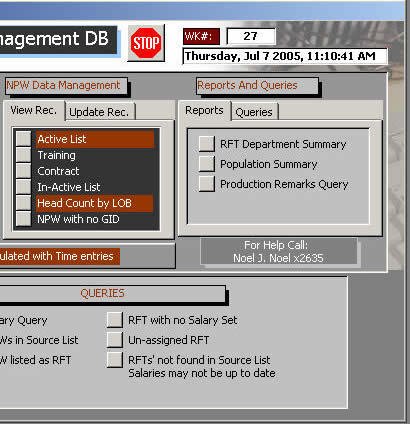
Microsoft Access Database Solutions: Create a working clock on your forms
Looking for that extra special effect to give your Microsoft Access database project a professional flair...Thought about adding a working clock to your Access forms?
To put a simple text clock on a form, create a Label called lblClock on the form, set the form's TimerInterval to 1000, and the following code behind the Timer Event.
You can also create two command buttons called cmdClockStart and cmdClockEnd and attach respective code to each to have the clock run on demand.

'***************** Code Start ***************
Private Sub Form_Timer()
Me!lblClock.Caption = Format(Now, "dddd, mmm d yyyy, hh:mm:ss AMPM")
End Sub
Private Sub cmdClockStart_Click()
Me.TimerInterval = 1000
End Sub
Private Sub cmdClockEnd_Click()
Me.TimerInterval = 0
End Sub
'***************** Code End ***************
Monday, July 04, 2005
How to eliminate white space in reports with CanShrink and code in Access 2002
| Article ID | : | 299011 |
| Last Review | : | June 23, 2005 |
| Revision | : | 5.0 |
This article was previously published under Q299011
For a Microsoft Access 97 version of this article, see 95390.
Moderate: Requires basic macro, coding, and interoperability skills.This article applies to a Microsoft Access database (.mdb) and to a Microsoft Access project (.adp).
For a Microsoft Access 2000 version of this article, see 210589.
On this page
 | SUMMARY | |
| MORE INFORMATION | |
| REFERENCES | |
| APPLIES TO | |
SUMMARY
Before you print a form or a report, you can save space by conditionally reducing the size of the controls on the form or report. For example, you might want to reduce the size of text boxes that contain varied-length text, or reduce the size of text boxes bound to fields that could be empty.
Before you try to reduce the size of controls in reports, however, consider the following:
Microsoft provides programming examples for illustration only, without warranty either expressed or implied. This includes, but is not limited to, the implied warranties of merchantability or fitness for a particular purpose. This article assumes that you are familiar with the programming language that is being demonstrated and with the tools that are used to create and to debug procedures. Microsoft support engineers can help explain the functionality of a particular procedure, but they will not modify these examples to provide added functionality or construct procedures to meet your specific requirements.
Before you try to reduce the size of controls in reports, however, consider the following:
| • | Overlapping controls will not shrink, even when the CanShrink property is set to Yes. |
| • | Controls shrink line by line (vertically). This means, for example, that if there is a group of controls placed on the left side of the page and a large control (for example, an OLE picture) on the right side of the page, the controls on the left side of the page will not shrink, unless the picture is blank and hidden. |
| • | Space between controls is not affected by the CanShrink or CanGrow property. |
| • | Controls located in the page header or page footer can shrink and grow. However, the sections do not have CanGrow and CanShrink properties. This means, you can still have blank space in a page header or page footer section (even though its controls may shrink). |

MORE INFORMATION
A control containing null information automatically shrinks to nothing and disappears when its CanShrink property is set to Yes, but the space between the controls is not affected by the CanShrink property.
For example, say you have 11 controls in a column of a report, and there is .1 inch of space between each control. Even if all 11 controls contain null information and all 11 have their CanShrink property set to Yes, the space between the controls adds up to 1 inch. When you print the report, even though the 11 controls are not printed, the first control that does contain text will be printed 1 inch lower than you might expect because of all the accumulated space.
A good way to manage the size of your controls is to have as few controls as possible. This will minimize the white space between the controls.
The following example demonstrates how to print mailing labels by using a Visual Basic function to minimize the number of controls and to give you even spacing. Say you want to create mailing labels containing a name, business name, address, city, state, and zip code. You could use several different fields, but it would be better to use a single text box, as in the following step-by-step example.
CAUTION: If you follow the steps in this example, you modify the sample database Northwind.mdb. You may want to back up the Northwind.mdb file and follow these steps on a copy of the database.
More info: http://support.microsoft.com/?kbid=299011
For example, say you have 11 controls in a column of a report, and there is .1 inch of space between each control. Even if all 11 controls contain null information and all 11 have their CanShrink property set to Yes, the space between the controls adds up to 1 inch. When you print the report, even though the 11 controls are not printed, the first control that does contain text will be printed 1 inch lower than you might expect because of all the accumulated space.
A good way to manage the size of your controls is to have as few controls as possible. This will minimize the white space between the controls.
The following example demonstrates how to print mailing labels by using a Visual Basic function to minimize the number of controls and to give you even spacing. Say you want to create mailing labels containing a name, business name, address, city, state, and zip code. You could use several different fields, but it would be better to use a single text box, as in the following step-by-step example.
CAUTION: If you follow the steps in this example, you modify the sample database Northwind.mdb. You may want to back up the Northwind.mdb file and follow these steps on a copy of the database.
More info: http://support.microsoft.com/?kbid=299011
Wednesday, June 22, 2005
Goto Record Command in a Form
This command comes very handy when you want to process the record one by one or test single records against another table.
Private Sub Form_Open(Cancel As Integer)
Dim intNPWCount As Integer
Dim strNPWGID As String
Dim FName As String
FName = Me.Form.Name
intNPWCount = Nz(DCount("[MPGID]", "MPW_Weekly_TimeTracker", "[DeptID]='" & Forms![ManpowerOTPopulationF].[ComboDeptID] & "' And [WKNO]=" & Forms![ManpowerOTPopulationF].[TxtWKNO]), 0)
If intNPWCount <> 0 Then
For A = 1 To intNPWCount
DoCmd.GoToRecord acDataForm, FName, acGoTo, A
‘Other Commands
Next A
Else
Exit Sub
End If
End Sub
Tuesday, June 14, 2005
How do I log users off a database and keep them off?
The following provides a methodology to allow the developer to schedule and enforce periods of downtime for any number of databases.
Define a database, ie, TimeCtl. All users should have read access to the database, but must not be able to change/move/delete the database or anything within the database.
Define a table, tblLogOut on the TimeCtl database having the following fields per row.
--ApplicationName text(50) primary key
--LogoffStart date/time
--LogoffEnd datetime
--Inactive Boolean
you will have one row for every active database. The application name is the database name only without the mdb. It is not the full path name. For example, if you database is DrugCourt.mdb the applicationname on tblLogOut is DrugCourt.
LogoffStart is the date and time you want to insure that all users cannot access applicationname. LogoffEnd is the date and time the users can begin to use applicationname again.
If the inactive flag is true, the record will never be checked again. This allows you to keep a historical track of your scheduled down time.
In TimeCtl, create a module called gfunctions (global functions). Cut and paste the following function into gfunctions.
Public Function funShutDown(DatabaseName As String) As Boolean: funShutDown = False
Dim db As Database
Dim rs As Recordset
Dim strSQL As String
DatabaseName = UCase(DatabaseName)
Dim myDate As Date: myDate = Now()
strSQL = "SELECT * FROM TBLLOGOUT WHERE APPLICATIONNAME = '" _
& DatabaseName & "' AND INACTIVE = 0 AND #" & myDate & "# BETWEEN LOGOFFSTART AND LOGOFFEND"
Set db = CurrentDb
Set rs = db.OpenRecordset(strSQL, dbOpenDynaset)
If rs.RecordCount = 0 Then
GoTo OutShutDown
Else
funShutDown = True
End If
OutShutDown:
rs.Close
Set rs = Nothing
Set db = Nothing
Exit Function
End Function
WATCH OUT FOR WORD WRAP.
On each database that is now represented on tblogout, establish a reference to the timecontrol database. This will allow you to call funShutDown from that database.
Link tbllogout to your database. Again, we don’t care if the user can see this table as long as he can’t do anything else but see information.
In your application database create an unbound form with one textbox. Place the following code on the open form event.
Private Sub Form_Open(Cancel As Integer)
If funShutdown(UCase("drug court")) = True Then
Application.Quit
End If
End Sub
This insures that a user who attempts to log on during the scheduled down time will fail to do so.
Set the forms timer interval to 300000 (5 minutes). The following is the forms timer event.
Private Sub Form_Timer()
If funShutdown("drug court") = True Then
Application.Quit
End If
End Sub
In the startup routine of your database, open this form hidden.
Every 5 minutes, your database will test if it should shut down. If down time is scheduled it will shut down within 5 minutes of the downtime start time.
Reference: http://www.tek-tips.com/faqs.cfm?fid=2145
Thursday, June 02, 2005
Hide a table in Database Window
(Q) Can I hide a table so that it doesn't appear in the Database window?
(A) If you want to hide a table in the database windows so that other users can't select it, preface the table's name with 'Usys'. For example, if your table's name is employee, change it to UsysEmployee. This makes your table into a system object which access does not display. To see this table later, choose view, options, show system objects.
More Reference: The Access Web
(A) If you want to hide a table in the database windows so that other users can't select it, preface the table's name with 'Usys'. For example, if your table's name is employee, change it to UsysEmployee. This makes your table into a system object which access does not display. To see this table later, choose view, options, show system objects.
More Reference: The Access Web
Thursday, May 12, 2005

Friday, May 06, 2005
Removing Filter of a Form through VBA
Procedure for Preset Filters:
Private Sub CMDRemoveFilter_Click()
Me.Filter = ""
End Sub
Explanation:
Double quote removes the filter.
Private Sub CMDRemoveFilter_Click()
Me.Filter = ""
End Sub
Explanation:
Double quote removes the filter.
Monday, May 02, 2005
Filtering a Form through VBA
Procedure for Preset Filters:
Private Sub CMDNullSalaries_Click()
Dim strNull As String
strNull = "(([Salary Query Form].[HR Salary] Is Null))"
Me.Form.Filter = strNull
Me.FilterOn = True
End Sub
Explanation:
Form “Salary Query Form” will display only the Record of whose “HR Salary” field contains nothing.
Private Sub CMDFilter_Click()
On Error GoTo Err_CMDFilter_Click
Dim vFilter As String
vFilter = Forms![Salary Query Form]![DeptFilterCombo]
Me.Filter = "DeptID = '" & vFilter & "'"
Me.FilterOn = True
Exit_CMDFilter_Click:
Exit Sub
Err_CMDFilter_Click:
MsgBox Err.Description
Resume Exit_CMDFilter_Click
End Sub
Explanation:
1. vFilter variable is declared.
2. vFilter variable takes the value from Forms![Salary Query Form]![DeptFilterCombo]
3. DeptID Field will then be filtered with the value from vFilter variable.
NOTE: If the variable contains string, then vFilter should be enclosed by single quote.
"DeptID = '" & vFilter & "'"
4. Declare Me.FilterOn as True. This is to activate filter.
Subscribe to:
Posts (Atom)